
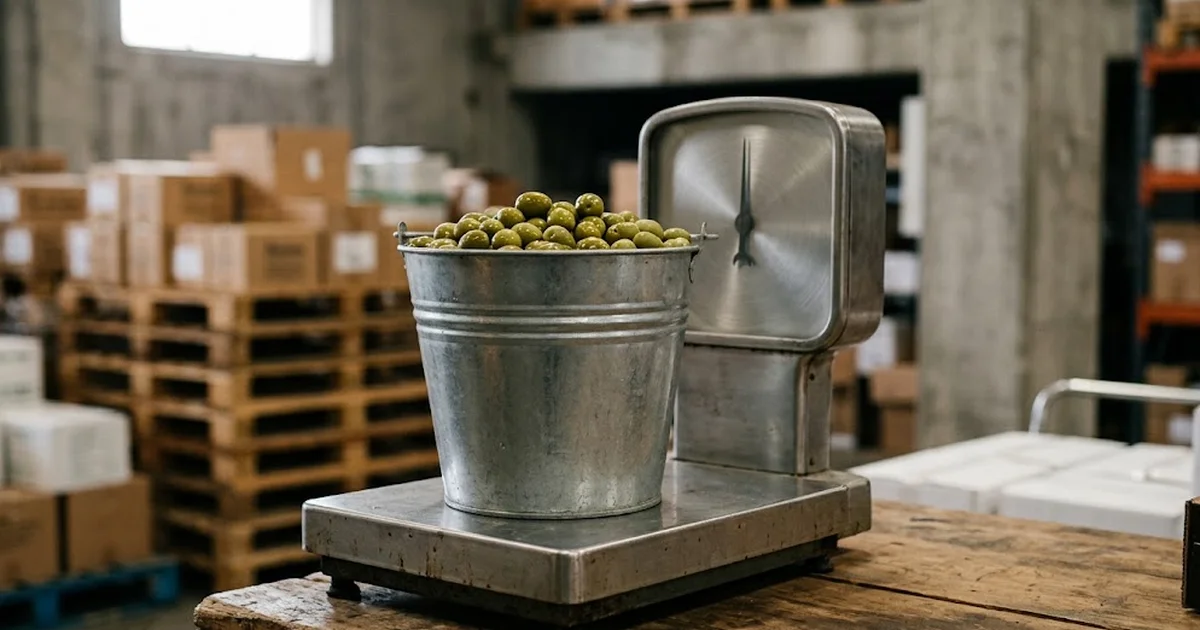
Poids net, poids égoutté, tare : ce que le client paie vraiment
Gross weight, net weight, drained net weight for olives and jars: method to recalculate the actual material cost and verify upon receipt. Professional guide for foodservice and fine grocery.
On a product sheet for olives, brined dried vegetables, or candied fruits in syrup, three terms often appear without being fully understood: gross weight, net weight, and drained net weight. For a professional buyer—whether in foodservice, gourmet retail, or catering—this distinction is not just an administrative detail; it determines the actual food cost per kilogram of usable product in the kitchen. A bucket advertised as 5 kg does not contain 5 kg of olives ready for plating: part of that weight is brine, syrup, or covering oil. This article explains the definitions, the method for recalculating the actual food cost, and the checks to perform upon receipt, without providing any drained weight percentages that are not listed on the product sheet for the specific batch.
Gross weight, net weight, drained net weight: definitions and differences for a bucket of olives or a jar
These three terms overlap on the same container but do not measure the same thing. Confusing one with another directly skews the profitability calculation for a recipe or a foodservice buffet.
| Term | What it measures | Where it appears | What it includes |
|---|---|---|---|
| Gross weight | Total weight of the shipped product | Delivery note, logistics label | Container (bucket, jar, carton) + product + covering liquid |
| Net weight | Weight of the contents excluding packaging | Product sheet, container label | Solid product + covering liquid (brine, syrup, oil) |
| Drained net weight | Weight of the solid product alone, after draining | Product sheet (mandatory for products in covering liquid) | Only the solid material usable in the kitchen |
For a bucket of olives or a jar of brined dried vegetables, the difference between net weight and drained net weight corresponds exactly to the volume of covering liquid. It is this last value—the drained net weight—that should be used as the basis for calculating food cost, not the net weight stated on the commercial label.
Why brine or syrup distort the actual food cost calculation in professional procurement
In foodservice and gourmet retail, food cost is calculated per kilogram of product actually plated, not per kilogram billed including liquid. Overlooking this nuance leads to underestimating the actual cost of a recipe using olives, candied fruits in syrup, or jarred dried vegetables.
- Brine or syrup is not billed at the same price as the solid product, but it contributes to the total advertised weight.
- A product advertised as “net weight 5 kg” may contain a significant portion of liquid depending on the variety, size, and packaging method.
- The drained net weight to net weight ratio varies from one batch to another, from one olive variety to another, and according to the fruit’s maturity or size.
- Only the product sheet for the delivered batch specifies the exact value to use—never a generic average applied blindly.
For a foodservice operator planning bulk orders and pallet deliveries, this precision avoids unpleasant surprises at month-end when the actual food cost exceeds the forecast based on gross weight.
Method for recalculating the actual food cost based on drained net weight
The calculation is straightforward provided the correct data is available: the drained net weight listed on the product sheet for the specific batch, never an approximate estimate.
The basic formula is as follows:
Actual food cost per usable kilogram = VAT-exclusive price paid for the container ÷ Drained net weight (kg) stated on the product sheet
Example calculation for illustrative purposes only, using fictional and rounded values to demonstrate the method:
- VAT-exclusive price paid for a bucket: €45.00
- Net weight stated on the label: 5 kg
- Drained net weight listed on the product sheet for this batch: X kg (to be systematically recorded from the sheet, never assumed)
- Cost per net kilogram (incorrect calculation if using gross or net weight): 45 ÷ 5 = €9.00/kg
- Cost per drained net kilogram (correct calculation): 45 ÷ X = actual cost, necessarily higher than the previous since X is less than 5 kg
This recalculation must be integrated into the technical sheet for each recipe using a product in covering liquid: pitted olives for a buffet, jarred dried vegetables for a garnish, candied fruits in syrup for pastry. This is the only way to obtain a reliable cost price, transferable to the calculation of the selling price and margin.
At Palimex, we regularly receive foodservice buyers who recalculate their food cost based on the gross weight displayed on the carton, without checking the drained net weight on the product sheet. Our field advice: before placing any bulk order for olives, jarred dried vegetables, or fruits in syrup, always request the drained net weight for the exact batch that will be delivered, not a product range average. Variations between batches exist, and ignoring this variable means managing profitability blindly.
Receiving checks: verifying net weight and drained weight in a foodservice warehouse or gourmet retail setting
Receiving checks are part of HACCP best practices and batch traceability, just like monitoring best-before and use-by dates. They allow for quick detection of discrepancies before the goods are stored or used.
- Check the gross weight upon delivery: weigh the entire package and compare it to the delivery note.
- Record the batch number and verify that it matches the provided product sheet or the one available upon order.
- For products in covering liquid, drain a representative sample using a colander or sieve for a standardised time, then weigh the solid residue.
- Compare the result to the drained net weight stated for this batch, accounting for a reasonable tolerance margin due to handling.
- Record any significant discrepancy in the receiving log and contact the supplier before storage or use.
This procedure naturally integrates into the receiving control protocol for foodservice and catering, alongside checks for cold chain integrity and container condition.
Tare, containers, and packaging: what to check for buckets, tins, and jars in bulk
Tare—the weight of the empty container—directly affects the net weight calculation upon receipt, particularly when the product is delivered in reusable plastic buckets or metal tins. A professional ordering in minimum 5 kg packaging must distinguish these elements to avoid confusion during a control weighing.
| Container type | Tare specifics | Key point to check upon receipt |
|---|---|---|
| Plastic bucket | Tare varies by thickness and size; weigh empty if strict control is required | Ensure the stated net weight excludes the bucket and lid weight |
| Metal tin | Heavier tare than plastic; not to be confused with the product’s net weight | Do not deduce net weight from a simple gross weighing without knowing the exact tare |
| Glass jar | Fixed tare but not negligible for small formats | Always compare to the drained net weight stated on the product sheet, never to the gross weight of the full jar |
For buyers managing stock rotation for olives and spreads in bulk or Cash & Carry, this careful reading of tare and net weight prevents stock valuation errors, particularly critical for high-turnover product ranges.
Bulk purchasing best practices for long-term control of actual food cost
Beyond one-off calculations, controlling the actual food cost relies on professional procurement habits to integrate into day-to-day bulk order management.
- Always request the product sheet for the batch before confirming a significant order, especially for olives, jarred dried vegetables, and candied fruits in syrup.
- Include the drained net weight—not the net or gross weight—in recipe technical sheets and margin calculation grids.
- Train receiving teams to distinguish gross weight, net weight, and drained net weight during quality control upon goods arrival.
- Maintain batch-by-batch traceability of observed discrepancies to identify any variations to report to the supplier.
- Plan storage: a product in covering liquid must be stored according to the product sheet’s recommendations to preserve the net weight to drained net weight ratio until consumption.
These practices align with the principles discussed in our article on optimal storage of dried and dehydrated fruits in warehouses, where batch traceability rigour plays an equally decisive role for products in covering liquid.
For mandatory information regarding net weight and drained net weight on food products, professional buyers may also consult public resources available on economie.gouv.fr as a supplementary information source.
Key takeaways: what professionals must remember before paying for a bulk bucket or jar
Gross weight, net weight, and drained net weight are not interchangeable synonyms: each measures a different aspect of the same container. For a professional buyer, only the drained net weight—stated on the product sheet for the delivered batch—allows for calculating a reliable and transferable actual food cost in a recipe technical sheet. The receiving check—weighing, batch control, sample draining if necessary—completes this system by securing traceability and order compliance. By systematically integrating this distinction into procurement, receiving, and margin calculation processes, foodservice, gourmet retail, and pastry professionals avoid profitability gaps linked to an approximate reading of weight statements.
Further reading
Frequently asked questions
Everything you need to know about this topic.
A question?
Get in touch directly.

Marketing & Communications Manager — Palimex / Meyva
As Marketing & Communications Manager at Palimex / Meyva, Aude Moyne leads the company's communications and digital marketing strategy: editorial content, email campaigns and the promotion of its product ranges. Her experience at Palimex, a specialist in dried fruit, nuts, olives and spices for professionals, has given her in-depth knowledge of the products, their origins and uses, and the expectations of food-industry professionals. The blog articles are written or supervised by her, in collaboration with Palimex's sales and product teams whenever a topic calls for specific expertise.
Our advice related to Pro-tips
Quality Dispute on a Batch: From Claim to Credit Note
Building a valid quality claim file: batch, photos, deadlines. Fact-based B2B procedure through to credit note or replacement at Palimex.
 pro-tips
Lot Inspection: How to Build a Representative Sample
Receiving a pallet: how many samples, how to distribute them, and which checkpoints to use for inspecting a lot of nuts, spices, or olives without opening everything.
 pro-tips
Shrinkage and Breakage: Measuring Bulk Aisle Losses
Breakage, dehydration, sampling, weighing errors: the Palimex method to measure each bulk B2B loss item and adjust your pricing without guesswork.