
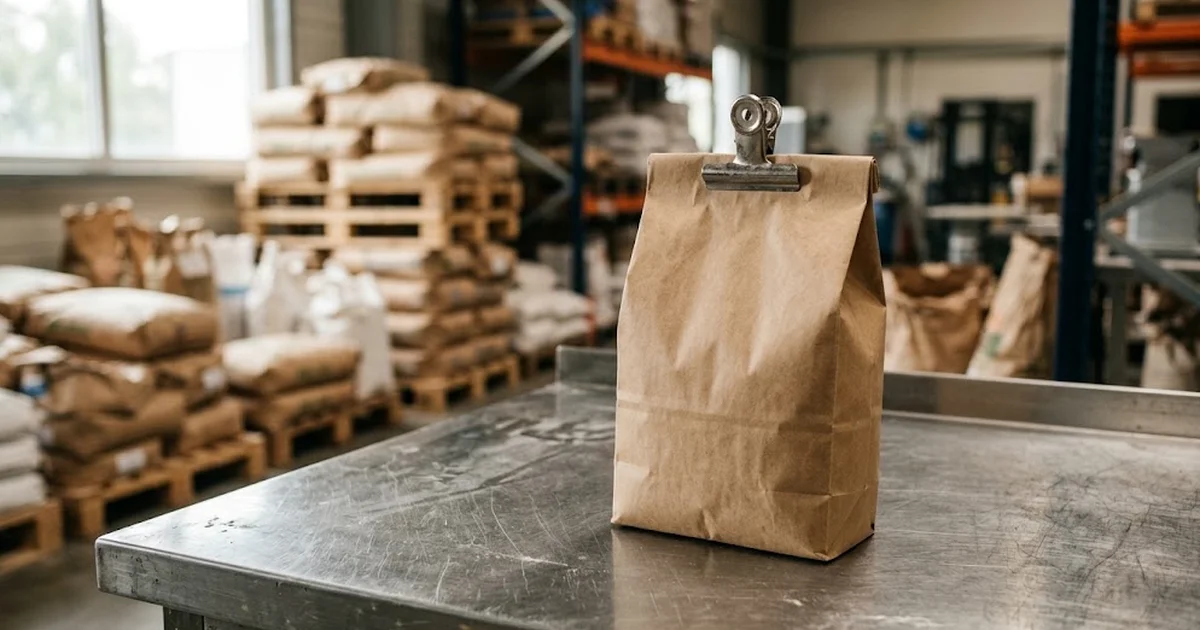
Étiquetage INCO : les mentions obligatoires sur un préemballé
INCO labelling for pre-packaged products: the 9 mandatory details, who is responsible during repackaging into bags, and B2B best practices.
For any professional buyer receiving a 25 kg bag of bulk dried fruits or spices and repackaging it into smaller pouches for resale, the question of labelling is not secondary: it involves their legal responsibility. The INCO Regulation (Consumer Information) governs the mandatory information that must appear on any prepackaged foodstuff placed on the market. This article outlines these requirements, what they mean in practice for a wholesaler, a foodservice operator (CHR), or a gourmet grocery store, and the key compliance points to integrate into your batch management.
The INCO Regulation and prepackaged foodstuffs: what exactly are we talking about
A foodstuff is considered "prepackaged" as soon as it is packaged before being offered for sale, in packaging that covers it entirely or partially, in such a way that the contents cannot be altered without the packaging being opened or modified. A sealed pouch of dried fruits, a jar of olives, a carton of candied fruits intended for resale: all fall under this definition as soon as they leave your warehouse to be offered to an end customer or a downstream professional.
The INCO Regulation sets out the list of information that must be provided to the buyer on the label itself, without reference to a separate notice or a mere oral statement. For a wholesaler like Palimex, which sells in minimum 5 kg packaging to professionals with a VAT number, the question arises differently than for a retail business: but as soon as a foodservice client, a pastry chef, or a gourmet grocery store repackages this bulk into smaller sales units for their own customers, they in turn become responsible for the labelling of these new prepackaged products.
Mandatory information on a prepackaged product: the checklist to know
The INCO Regulation requires a core set of information that must appear on the label of a prepackaged foodstuff. Here are the elements that consistently appear in compliance checks and audits:
- The name of the food: the precise and non-misleading name under which the product is sold (e.g., "pitted dried apricots", not a vague description).
- The list of ingredients, in descending order of weight, for any product composed of multiple elements (aperitif mixes, coated candied fruits, spice blends).
- Allergens, highlighted through typography, case, or colour contrast to clearly distinguish them from the rest of the ingredient list.
- The net quantity, expressed in the appropriate unit of measurement (kg, g, L depending on the product type).
- The date of minimum durability (best-before date) or the use-by date, depending on the product type and its microbiological sensitivity.
- Storage conditions and, where applicable, instructions for use after opening.
- The name or business name and address of the operator responsible for placing the product on the market (manufacturer, packer, or reseller as applicable).
- Origin, when required by the regulations applicable to the product in question.
- The nutrition declaration, presented in a standardised format (energy value and nutrient content).
This list forms the common foundation. Certain product categories (spice blends, treated dried fruits, olives in brine) may be subject to additional requirements depending on their exact composition. For the precise regulatory text and its updates, the reference authority remains the DGCCRF, which publishes practical guides applicable to each food category.
Summary table: information, source, and compliance responsibility
To clarify who must verify what during repackaging, here is a concise table of the mandatory information and the key compliance points for a B2B buyer transferring a batch into pouches.
| Mandatory information | Where to find it when purchasing in bulk | Key compliance point during repackaging |
|---|---|---|
| Name of the food | Delivery note / supplier product sheet | Use an accurate name, without shortening or modifying it |
| List of ingredients | Supplier technical sheet | Mandatory as soon as there is a mix or preparation |
| Allergens | Technical sheet / original bag label | Must remain highlighted on the new packaging |
| Net quantity | Weighing at the time of pouching | Must exactly match the actual content of the pouch |
| Best-before date / use-by date | Label of the original packaging (25 kg, carton) | Never exceed the original date during repackaging |
| Storage conditions | Supplier technical sheet | Adjust if the new format alters the product’s sensitivity |
| Operator’s name | N/A | The professional repackaging becomes responsible for this information |
| Origin (if required) | Supplier product sheet / batch traceability | Never state an origin not traced to the original batch |
| Nutrition declaration | Supplier technical sheet | Reproduce as-is or recalculate if the product is processed |
Repackaging into pouches: who bears responsibility for the label
This is the question most frequently asked by professionals who purchase in 5, 10, or 25 kg bags to resell in smaller units: when a bag of dried fruits leaves our warehouse with its original labelling, and the customer transfers it into pouches for their own clientele, who is responsible for the final label?
The answer is based on a simple principle: as soon as an operator modifies the packaging of a foodstuff, they become the operator responsible for placing this new prepackaged product on the market, and thus responsible for the compliance of its labelling. The 25 kg bag sold by a wholesaler carries the information relevant to this bulk sales format; it does not exempt the buyer who repackages from creating a complete and compliant label on their own pouches.
At Palimex, we regularly see foodservice clients or gourmet grocery stores who believe that the label on the original bag "automatically covers" their own resale pouches. This is not the case: as soon as you open a 25 kg bag to divide it into smaller units, you become responsible for the label affixed to these new containers. Our field advice: always keep the technical sheet and the batch number of the original product, as they form the basis of your own labelling and traceability in the event of an inspection.
In this context, it is essential to retain all the information provided with the original batch—exact name, list of ingredients, allergens, best-before date, origin if stated—to be able to reproduce it accurately on the final label, without approximation or extrapolation.
Allergens and nutrition declaration: the most common sources of errors
Two categories of information account for the majority of non-compliance issues observed in practice, particularly among professionals handling nuts, spice blends, or aperitif preparations.
- Allergens: A mix of dried fruits and nuts, an aperitif assortment containing sesame, or a spice preparation with mustard must have these allergens clearly identified on the label, even after repackaging. The risk of cross-contamination between different batches handled in the same repackaging facility must also be addressed in your HACCP plan.
- The nutrition declaration: It can be reproduced as-is from the supplier’s technical sheet if the product is not processed, but must be recalculated if you create a blend or preparation composed of multiple raw materials with different nutritional profiles.
These two points alone justify implementing a documented repackaging procedure, integrated into your food safety management plan, with systematic verification of technical sheets before any change in packaging or format.
Best practices to secure your batches during repackaging and resale
Beyond the list of mandatory information, batch documentation is what allows you to respond confidently to an inspection. Here are the key practices to implement:
- Always retain supplier technical sheets for each product, filed by batch number and receipt date.
- Check the best-before date or use-by date of the original product before any repackaging, and never extend a date beyond that of the original bag or carton.
- Create a standard label template incorporating all nine mandatory pieces of information, to be adapted product by product rather than recreated each time.
- Train packaging teams to highlight allergens on the new packaging, not just to verify net weight.
- Document upstream-downstream traceability: which supplier batch was used to produce which batch of resale pouches, with corresponding quantities.
- Refer to the DGCCRF’s practical guides in case of doubt about a specific requirement for a product category (spices, treated dried fruits, olives in brine).
This rigorous documentation is especially important for professionals who purchase in bulk for resale: see our article on bulk packaging for pastry chefs and artisans for available formats, or our guide on the difference between best-before and use-by dates for dried fruits to refine your date management.
Stock rotation, storage, and compliance: an inseparable trio
Compliant labelling only makes sense if it is supported by rigorous stock management. A poorly anticipated best-before date, slow stock rotation for a 5 kg format, or non-compliant storage conditions in the warehouse can render otherwise correct labelling invalid at the time of packaging.
For professionals managing multiple references of dried fruits, dehydrated fruits, or spices simultaneously, it is recommended to cross-reference three elements before each repackaged sale:
- The batch receipt date and its original best-before date.
- The actual storage conditions applied (temperature, humidity, light exposure) compared to those prescribed by the supplier.
- The expected time between repackaging and the actual sale to the end customer.
This approach aligns with the issues discussed in our article on storing dried fruits in a professional warehouse, as well as the recommendations on pallet logistics and free delivery in B2B, two factors that directly impact the reliability of your labels over time.
Key takeaways: what to remember about INCO labelling for prepackaged products
The INCO Regulation requires nine categories of information on any prepackaged foodstuff: name of the food, list of ingredients, allergens, net quantity, best-before date or use-by date, storage conditions, operator’s name, origin when required, and nutrition declaration. For a professional buyer receiving bulk in 5 to 25 kg bags and repackaging it for their own customers, responsibility for this labelling falls to them as soon as they modify the sales format. The best protection remains rigorous documentation of supplier batches, a standardised internal repackaging procedure, and systematic verification of current regulations via the DGCCRF in case of doubt about a specific product category.
Further reading
Frequently asked questions
Everything you need to know about this topic.
A question?
Get in touch directly.

Marketing & Communications Manager — Palimex / Meyva
As Marketing & Communications Manager at Palimex / Meyva, Aude Moyne leads the company's communications and digital marketing strategy: editorial content, email campaigns and the promotion of its product ranges. Her experience at Palimex, a specialist in dried fruit, nuts, olives and spices for professionals, has given her in-depth knowledge of the products, their origins and uses, and the expectations of food-industry professionals. The blog articles are written or supervised by her, in collaboration with Palimex's sales and product teams whenever a topic calls for specific expertise.
Our advice related to Pro-tips
Quality Dispute on a Batch: From Claim to Credit Note
Building a valid quality claim file: batch, photos, deadlines. Fact-based B2B procedure through to credit note or replacement at Palimex.
 pro-tips
Lot Inspection: How to Build a Representative Sample
Receiving a pallet: how many samples, how to distribute them, and which checkpoints to use for inspecting a lot of nuts, spices, or olives without opening everything.
 pro-tips
Shrinkage and Breakage: Measuring Bulk Aisle Losses
Breakage, dehydration, sampling, weighing errors: the Palimex method to measure each bulk B2B loss item and adjust your pricing without guesswork.