
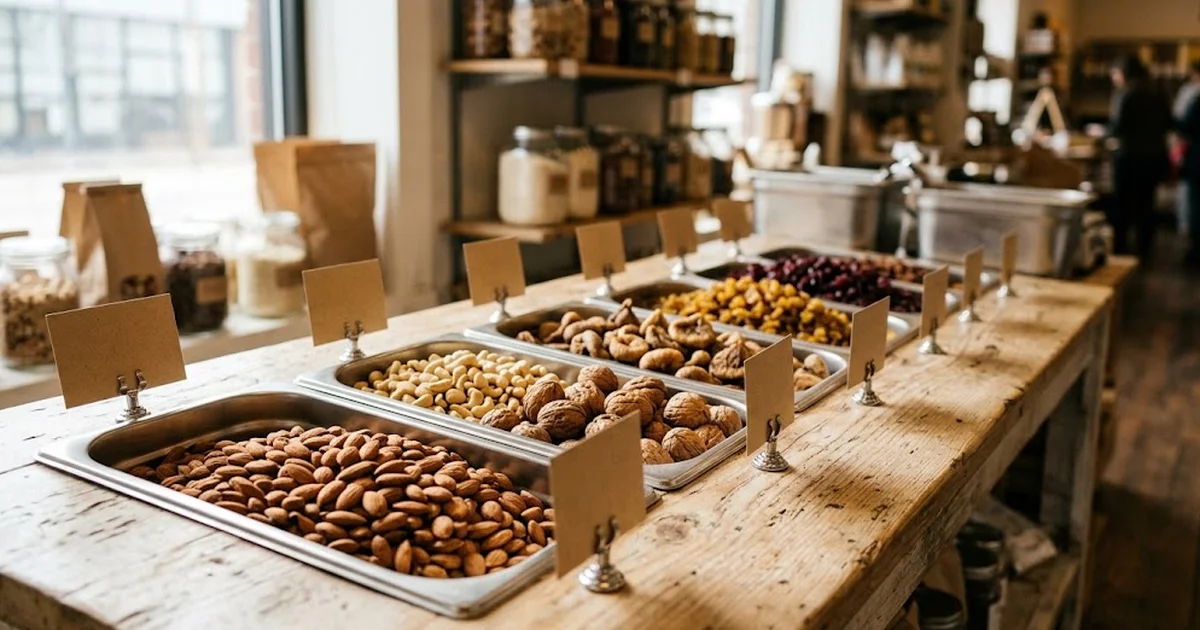
Vente en vrac : ce que la loi impose d'afficher au point de vente
Product name, allergens, origin, best-before date, price per kilogram: what regulations require to display on bulk shelves. Practical guide for grocery stores and greengrocers.
Opening a bulk section in a fine grocery store or a fresh produce shop requires particular rigour when it comes to consumer information. Unlike a pre-packaged product with a label already displaying all legal information, a product sold by weight from a bin, a self-service bag, or a counter blackboard must be subject to specific signage, updated with each batch rotation. This article outlines what regulations require to be displayed at the point of sale for dried fruits, dehydrated fruits, spices, olives, and other bulk-sold products—a topic distinct from the issue of customer-provided containers, already covered in our article on the AGEC law and bulk containers.
Bulk sales and AGEC law: two regulations not to be confused
Many retailers setting up their bulk section mix up two distinct obligations. The AGEC law governs the customer’s ability to bring their own container and the hygiene conditions associated with this practice. The information due to the consumer about the product itself—its nature, allergens, origin, date, and price—falls under a different regulatory framework, that of consumer information and food labelling.
This distinction is not merely an administrative nuance. A point of sale can be fully compliant with customer container acceptance while entirely failing on product signage, or vice versa. Both aspects must be addressed separately in the section’s organisation.
- AGEC law: conditions for accepting and ensuring the cleanliness of customer-provided containers.
- Consumer information: details to be displayed for each product sold by weight, regardless of the container used.
Mandatory information to display for each bulk-sold product
When a food product is sold without prior packaging, the signage at the point of sale must enable the customer to access, before purchase, the same information guarantees as a pre-packaged product. In practice, this applies to every bin, dispenser, and tray offered in self-service or served at the counter.
- The sales description: precise name of the product (e.g., "pitted dried apricots", "unsalted shelled almonds"), not a vague commercial name.
- The list of allergens present in the product or potentially present due to cross-contamination in the assortment.
- The origin, when this is a mandatory mention for the product category in question.
- The best-before date (BBD) or, depending on the product, the use-by date applicable to the current batch on sale.
- The price per kilogram, displayed legibly and in close proximity to the container.
This information must be visible when the customer makes their choice, not solely on the receipt. For retailers managing multiple successive batches of the same product—a common practice for dried fruits and dehydrated fruits where supplies rotate regularly—the signage must be updated with each batch change, particularly for the best-before date. We detail this management in our article on the difference between BBD and use-by dates for professionals.
Summary table: what to display based on bulk-sold product ranges
Display requirements are not strictly identical depending on the product type. Below is a summary table highlighting key points of attention by major product family, commonly found at Palimex and frequently resold in bulk by our grocery customers.
| Product family | Precise description | Allergens to monitor | Origin | BBD / rotation |
|---|---|---|---|---|
| Dried fruits and nuts (almonds, walnuts, hazelnuts, pistachios) | Variety, treatment (shelled, roasted, salted) | Nuts, possible traces depending on packaging lines | Often expected by foodservice customers | Rapid rotation recommended, high sensitivity to rancidity |
| Dehydrated fruits (apricots, figs, dates, raisins) | Fruit, process (pitted, soft, sulphured) | Sulphites common in apricots and some sulphured fruits | Depending on batch origin | BBD to be updated with each batch change |
| Spices and blends | Spice name or blend composition | Rare, but vigilance required for compound blends | Relevant for quality enhancement | Slower rotation, moisture control in the bin |
| Olives and spreads | Variety, preparation (pitted, marinated) | Depending on marinade (mustard, nuts) | Depending on batch provenance | Preservation in brine, short BBD once opened |
| Dried vegetables | Precise name (green lentils, split peas, beans) | Generally low risk | Not strictly required | Slow rotation, sensitivity to ambient humidity |
Allergens and nuts: the sensitive issue in bulk sections
Bulk sections present a particular risk for grocery stores selling dried fruits and nuts side by side: cross-contamination between adjacent bins. A shared scoop, a spill during restocking, or almond dust migrating to the raisin bin—these common situations have direct consequences for allergic customers.
The signage must therefore mention not only the allergens intrinsic to the product but also the risk of traces due to the section’s layout. We recommend our customers document this analysis in their HACCP control plan, just as they would for batch traceability. This topic is explored further in our dedicated article on allergen labelling for nuts and dried fruits.
- Physically separate nut bins from other product families.
- Assign a dedicated scoop or utensil per bin, with no sharing.
- Train sales staff to provide precise information on composition and present allergens.
- Retain delivery notes and product sheets to trace each batch in case of customer queries.
At Palimex, we have been supporting grocers and fresh produce retailers in opening or reorganising their bulk sections since 1984. Field feedback is consistent: most non-compliance issues stem not from ill will but from signage not being updated after a batch change. Our advice: systematically link bulk section relabelling to your goods receipt procedure, just as you would check the BBD upon the truck’s arrival.
Blackboards, labels, bin tags: organising signage without errors
The signage medium is not prescribed by regulations, but its organisation determines the reliability of the information. A handwritten blackboard that is not updated is as risky as no signage at all. Below are the practices we recommend to our professional customers to ensure this point is reliable.
- One bin tag per container, positioned directly at the product level, not grouped at the end of the section.
- A standardised template listing, in the same order, the description, allergens, origin, BBD, and price per kilo to avoid omissions.
- A restocking checklist requiring label verification with each bin refill, not just at the start of the day.
- A designated team member responsible for updating information with each new delivery.
This organisation directly aligns with the challenges of stock management and rotation in grocery stores: a well-labelled bulk section is also one where rotation is controlled, reducing losses and near-BBD unsold items.
Inspections, responsibility, and daily best practices
Responsibility for point-of-sale signage lies with the retailer selling the product to the end consumer, not the wholesaler who delivered the goods in professional packaging. Inspections related to consumer information in retail sales fall under the Directorate General for Competition, Consumer Affairs, and Fraud Control (DGCCRF), which publishes updated resources for professionals. We encourage every customer opening a bulk section to consult the current information on the official DGCCRF website before finalising their signage, as regulations may evolve.
Daily, a few simple habits can secure the section in the long term:
- Verify consistency between the delivery note, batch number, and the label displayed in the section.
- Never repack a new batch in a bin without removing the old label.
- Retain a copy of each displayed label for a duration consistent with your traceability plan.
- Train each new employee on reading product sheets before they start working in the section.
- In case of doubt about a mandatory mention, refer to DGCCRF resources rather than practices observed elsewhere.
Structuring a compliant bulk section: the Palimex summary
Regulatory signage at the bulk point of sale rests on five pillars: precise description, allergens, origin when required, up-to-date BBD, and legible price per kilo. These obligations are independent of the AGEC law on customer-provided containers, which addresses a completely different aspect of bulk sales. For grocers and fresh produce retailers setting up or evolving their section, the key lies in organisation: a single label template, a systematic procedure with each batch receipt, and heightened vigilance for product families sensitive to allergens, such as nuts.
Palimex supplies its professional customers with packaging suitable for bulk resale, including the batch and traceability information necessary for reliable relabelling at the point of sale. For any questions about the logistical organisation of your bulk section or our available ranges in bulk packaging, our team remains at your disposal from our Rungis platform.
Further reading
Frequently asked questions
Everything you need to know about this topic.
A question?
Get in touch directly.

Marketing & Communications Manager — Palimex / Meyva
As Marketing & Communications Manager at Palimex / Meyva, Aude Moyne leads the company's communications and digital marketing strategy: editorial content, email campaigns and the promotion of its product ranges. Her experience at Palimex, a specialist in dried fruit, nuts, olives and spices for professionals, has given her in-depth knowledge of the products, their origins and uses, and the expectations of food-industry professionals. The blog articles are written or supervised by her, in collaboration with Palimex's sales and product teams whenever a topic calls for specific expertise.
Our advice related to Pro-tips
Quality Dispute on a Batch: From Claim to Credit Note
Building a valid quality claim file: batch, photos, deadlines. Fact-based B2B procedure through to credit note or replacement at Palimex.
 pro-tips
Lot Inspection: How to Build a Representative Sample
Receiving a pallet: how many samples, how to distribute them, and which checkpoints to use for inspecting a lot of nuts, spices, or olives without opening everything.
 pro-tips
Shrinkage and Breakage: Measuring Bulk Aisle Losses
Breakage, dehydration, sampling, weighing errors: the Palimex method to measure each bulk B2B loss item and adjust your pricing without guesswork.