

Available products
13 references

Looking for a wholesale dried fruit supplier?
I'm Jessica, your dedicated wholesale account manager.
Direct sourcing — Rungis and Bordeaux.
- ✓Direct sourcing from producers
- ✓Quality controlled (shelf-life, calibre, origin)
- ✓Next-day delivery in Île-de-France
- ✓Bulk, custom packaging, co-packing
- ✓B2B account with pricing tiers
Shipping & pickup
Rungis pickup
Pick up your order at our Rungis market depot. By appointment Monday through Friday.
Nationwide delivery
Delivery within mainland France and major European cities. Indicative lead time 24-48h.
Careful packaging
Reinforced cardboard, anti-shock padding, traceability labels.
Frequently asked questions
About this category
Granules, powder or slice: three grinds, three uses
Dehydrated garlic is rarely bought on taste: it is bought on grind. The grind decides where the product dissolves, where it stays visible, and how fast it releases its aroma. Three particle sizes cover most needs in a professional kitchen.
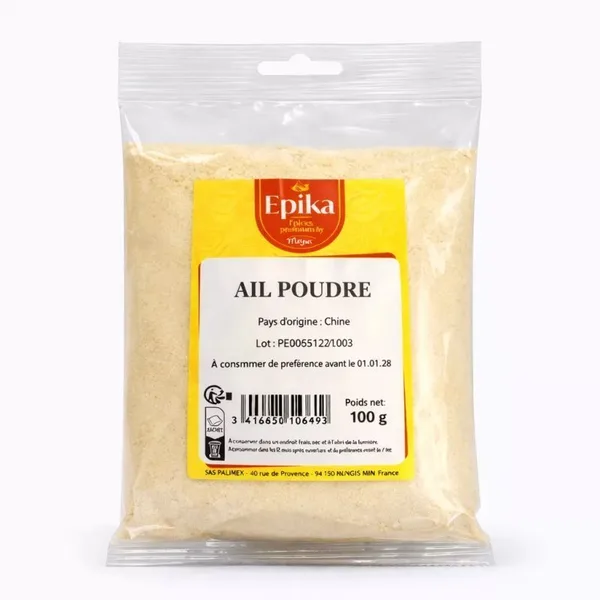
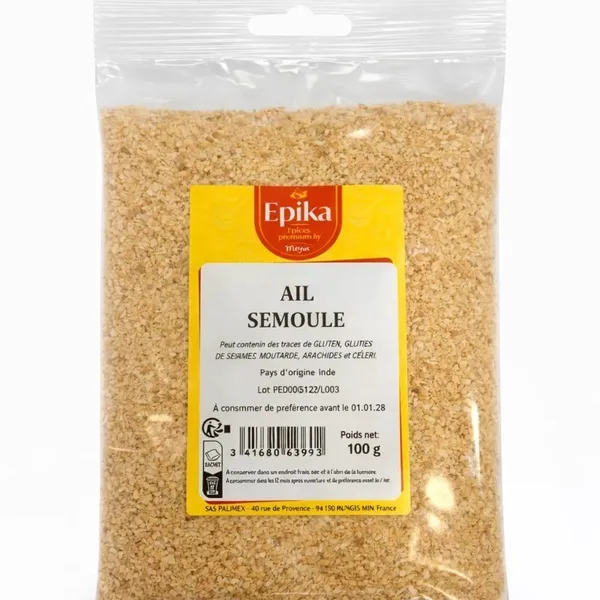
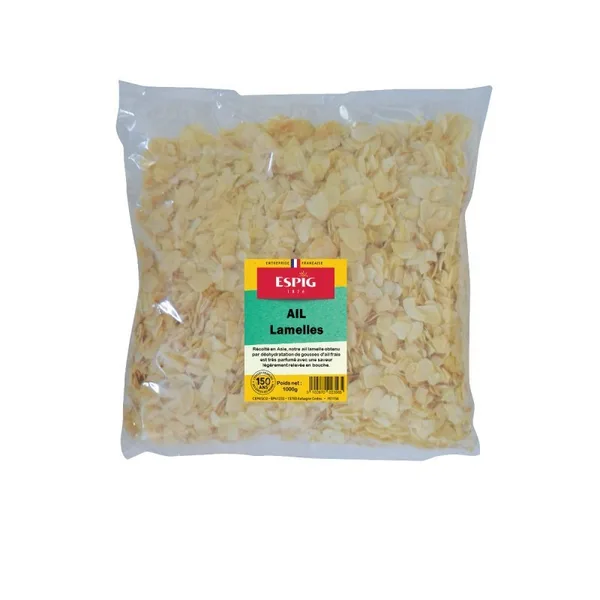
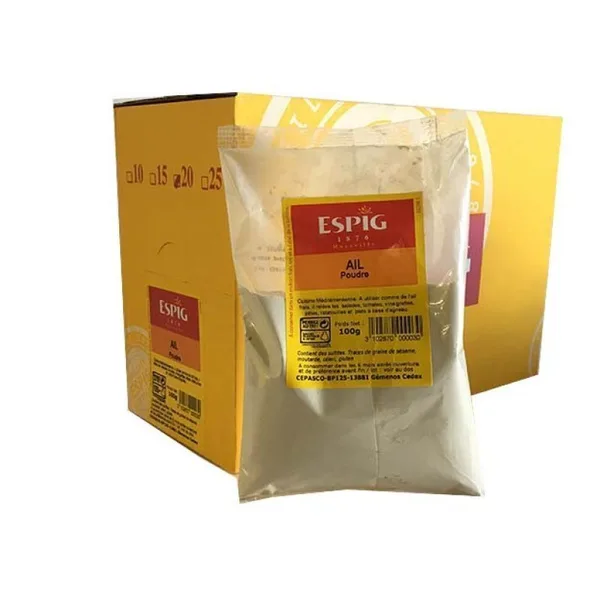
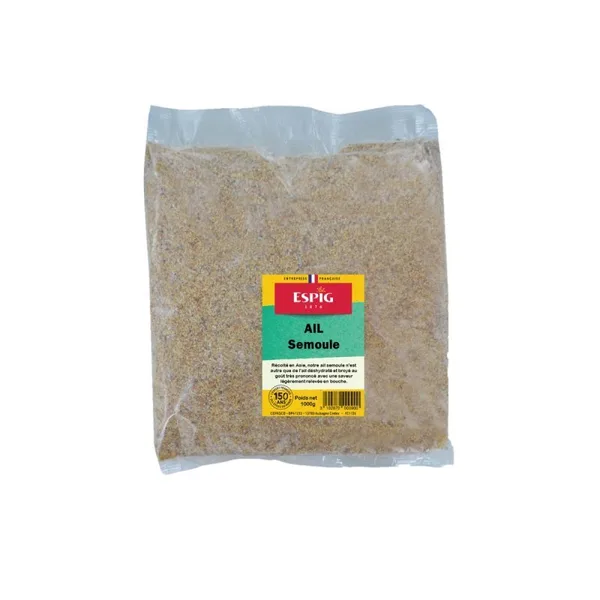
Ground garlic, the finest, vanishes into a mass: sauce, marinade, batter, breading. It acts quickly and spreads without leaving a visible speck. Garlic granules, slightly coarser, are the all-round format of the aisle: they hold up to cooking, measure by the spoon and show just enough to signal their presence. Garlic slices, finally, keep a recognisable shape and work as garnish as much as seasoning — on a focaccia, in a pan, on a finished plate.
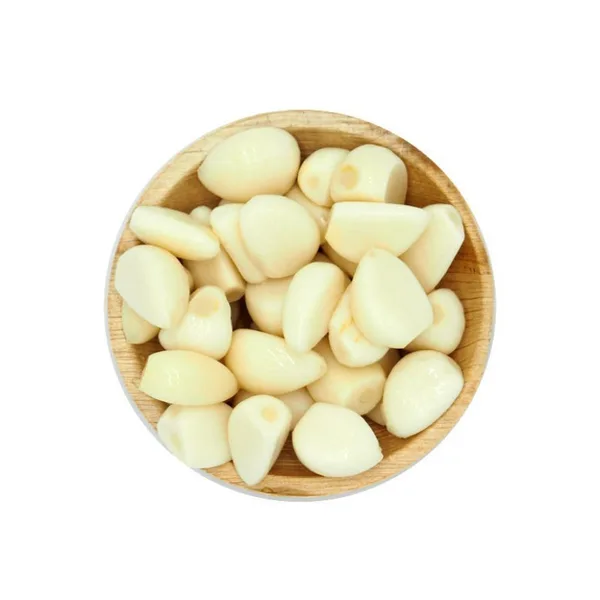
Beside those three dry forms, garlic confit in brine in a 5 kg pail plays an entirely different role: whole ready-to-use cloves, tender texture, for the amuse-bouche, the buffet and the tapas board.
| Form | Available formats | Main use |
|---|---|---|
| Ground garlic (powder) | 1 kg, 20x100 g | sauces, marinades, breadings — dissolves |
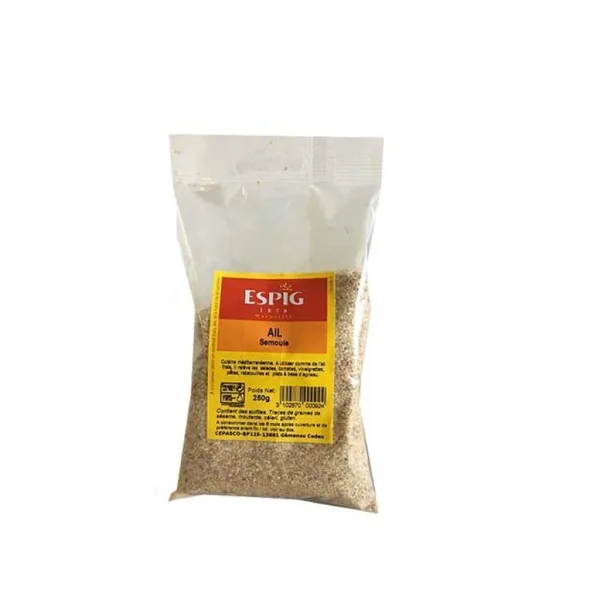
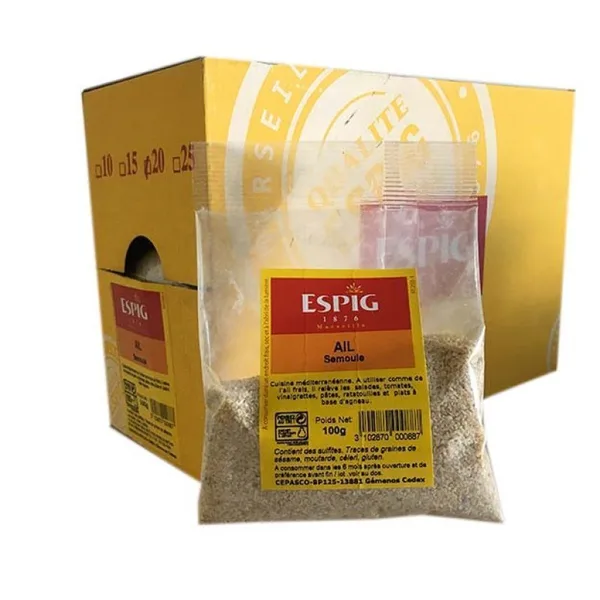
| Garlic granules | 250 g, 1 kg, 15x100 g, 20x100 g | all-round, holds up to cooking |
| Garlic slices | 1 kg | visible garnish, pan dishes, pasta |
| Garlic confit in brine | 5 kg pail | whole cloves, tapas, buffet |
What dehydrated garlic changes in a kitchen
The calculation is rarely made on price per kilo. It is made on what disappears from the workstation:
- Peeling — the most expensive task, and the only one that never shows on the menu.
- Variability — one clove does not carry the strength of the next; a spoon of granules does.
- Loss — fresh garlic sprouts and softens; the dehydrated form waits in its case.
- Chilled storage — where space is always short, the spice stays in the dry store.
Two brands share the dry aisle, and they do not answer the same need. Espig covers the widest scale of formats — from the 250 g bag for the small establishment to the 1 kg bag for production, up to the 20x100 g case intended for resale. Epika comes in 15x100 g and 20x100 g cases, a packaging designed for the shelf and for the grocer who sells by the unit. The choice between the two is therefore made on where the product ends up, far more than on taste: a kitchen station consumes 1 kg, a shelf sells 100 g.
This reasoning holds for volume catering, sandwich bars, sauce production and savoury catering. It holds less where fresh garlic is itself a menu argument — that is a positioning choice, not a technical one.
Wild garlic: the spreadable aside
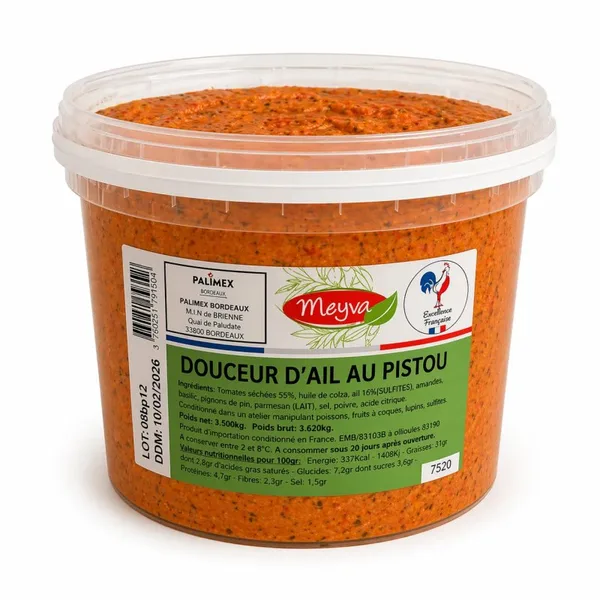
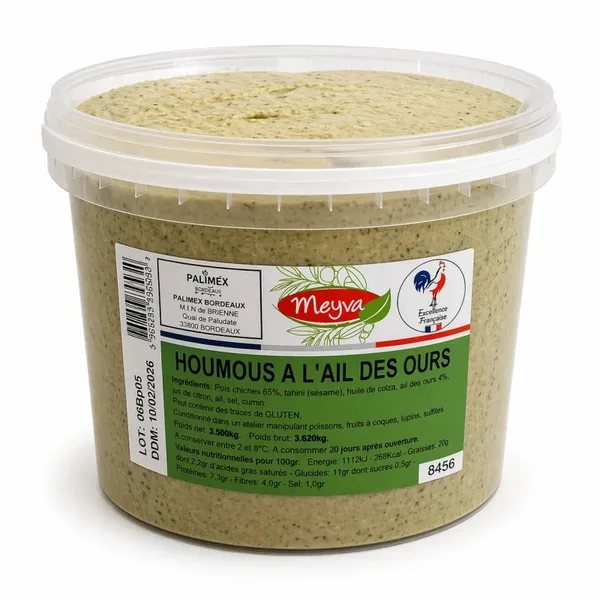
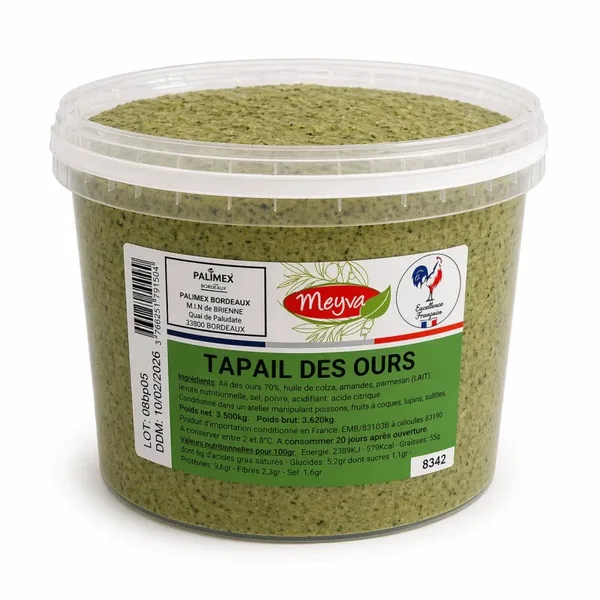
The aisle also carries three MEYVA preparations in 3.5 kg pails built around wild garlic: wild garlic houmous, wild garlic tapail and garlic pesto douceur. These are not spices but ready-to-serve spreads, useful for amuse-bouches and aperitif boards.
We advise keeping two grinds, never just one: the powder for what must disappear, the granules for what must be noticed. A kitchen with only one of the two always ends up over-dosing.— The Palimex team
Storage, dosing and the regulatory frame
Dehydrated garlic is hygroscopic: it takes up moisture from the air and clumps into blocks as soon as the container stays open. An opened case must be closed again, and the serving spoon must be dry — one damp spoon is enough to set a whole bag solid. In a dry store, away from light and heat sources, the product keeps its flowability throughout its shelf life.
A practical note on dosing: dehydrated garlic rehydrates in the dish, and its intensity climbs during the first minutes of cooking. Added at the end of service it stays discreet; added at the start of a preparation it quickly takes up all the room. We advise dosing early and then tasting, rather than correcting at the end.
Garlic is a treated crop like any other, and the maximum residue levels for pesticides in plant products are set by Regulation (EC) No 396/2005, a useful reference for any establishment building its food safety plan or answering a customer specification.
The neighbouring spices
Garlic rarely works alone. In the same aisle:
- Dehydrated shallot — the same logic, a gentler profile
- Culinary herbs — parsley, thyme, bay
- Paprika — the colour that goes with garlic
- Spice blends — when the garlic arrives already measured