
Available products
6 references

Looking for a wholesale dried fruit supplier?
I'm Jessica, your dedicated wholesale account manager.
Direct sourcing — Rungis and Bordeaux.
- ✓Direct sourcing from producers
- ✓Quality controlled (shelf-life, calibre, origin)
- ✓Next-day delivery in Île-de-France
- ✓Bulk, custom packaging, co-packing
- ✓B2B account with pricing tiers
Shipping & pickup
Rungis pickup
Pick up your order at our Rungis market depot. By appointment Monday through Friday.
Nationwide delivery
Delivery within mainland France and major European cities. Indicative lead time 24-48h.
Careful packaging
Reinforced cardboard, anti-shock padding, traceability labels.
Frequently asked questions
About this category
Wholesale paprika, the one spice bought first for its colour
Wholesale paprika is not bought the way the rest of the aisle is. A cumin or a pepper is chosen for its aroma; a paprika is chosen for what it does to the plate before anyone has tasted it. It is what gives a sauce, a marinade, a homemade chorizo or a slow-cooked dish its red — and a batch is judged on that colour, held or lost. A food wholesaler since 1984, Palimex lists this aisle under the Epika and Espig labels, from the 500 g bag to the 20x100 g case.
That primacy of colour bears directly on buying: a paprika that has faded has not merely lost its looks, it has lost the very thing it was ordered for. A professional buyer is therefore well advised to read this aisle in terms of stock turnover as much as price per kilo.
Sweet noble and smoked: two ingredients, not two strengths
The aisle reads as two profiles, and the commonest confusion is to take them for two notches on a single scale. Ground sweet noble paprika is a background seasoning: it colours, it rounds out, it goes in by the spoonful without ever taking over. Smoked paprika is an ingredient in its own right, carrying a woody note that signs the dish — and that, used at the sweet one's dose, flattens everything else.
The practical rule fits in a sentence: the sweet one is measured in spoons, the smoked one in pinches. A cook who swaps one for the other gram for gram gets an unbalanced dish, not a stronger one. It is a correction we see regularly on first orders.
What the aisle holds
The range is deliberately short and legible:
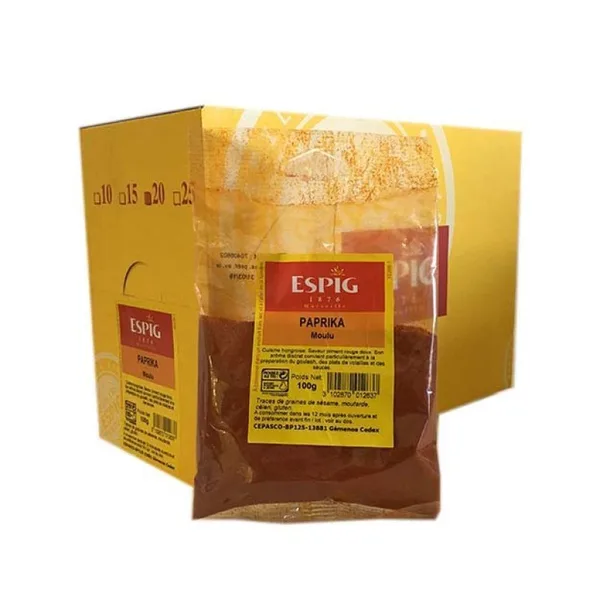
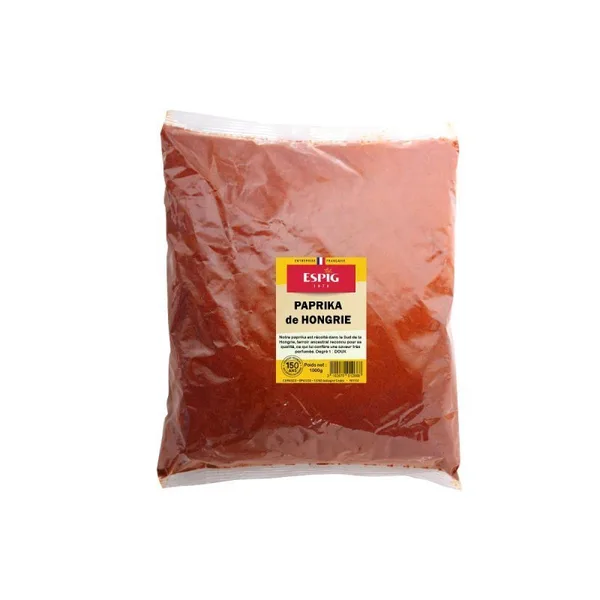
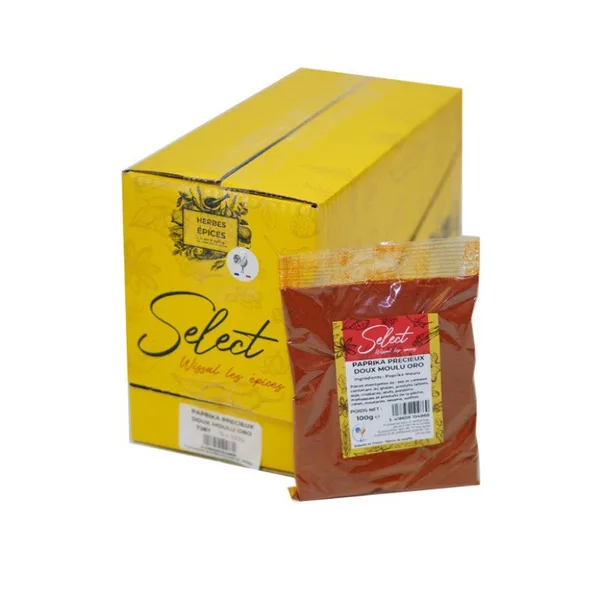
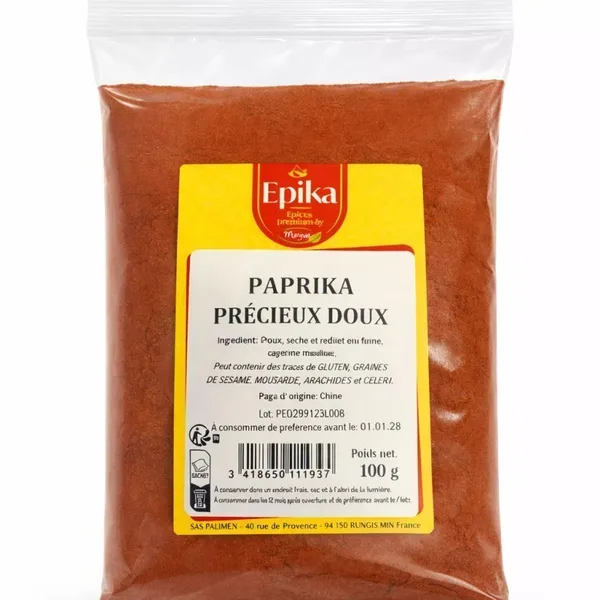
- Ground sweet noble paprika, from Espig in 20x100 g cases and in 1 kg bags, and from Epika in 20x100 g cases.
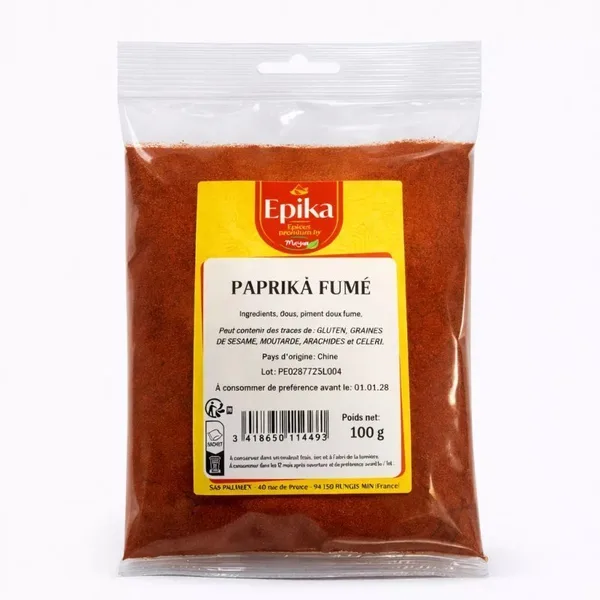
- Smoked paprika, from Epika as well as from Espig, in 20x100 g cases.
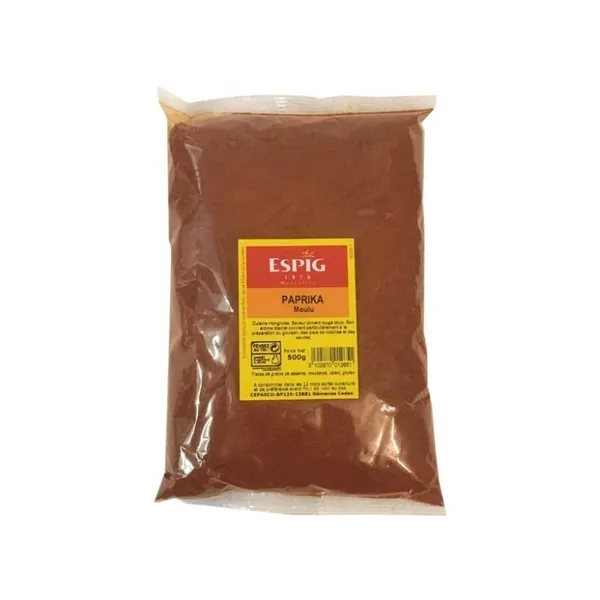
- Paprika in a 500 g bag, the entry format of the aisle for a kitchen with moderate use.
The two labels mirror each other at identical pack sizes on the essentials, which leaves you free to decide on something other than format. If it is heat rather than colour you are after, wholesale chilli takes over; if it is a yellow rather than a red, wholesale turmeric plays the same role on another part of the colour range.
Pack sizes, and the kitchen rhythm they assume
The table below sets out the three pack sizes of the aisle. They differ not in quality but in how fast the establishment gets through them.
| Pack size | References concerned | Usage profile |
|---|---|---|
| 500 g bag | Espig paprika | Moderate use, single station, standby stock |
| 20x100 g case | Sweet noble and smoked, Epika and Espig | Several stations, or shelf stock in a delicatessen |
| 1 kg bag | Espig ground sweet noble | Steady production, central kitchen, sauces by volume |
Here the case of units has an advantage the kilo does not: each 100 g unit stays sealed until it is opened, and paprika only begins to fade from that moment on. Conversely, an establishment building sauces every week has no reason to pay for portioning: the 1 kg bag is made for it. The trade-off is not one of price, it is one of rhythm.
Dosing colour without burning it
Paprika has a fragility of its own that other powders do not: taken too hot and too dry, it turns brown and bitter within seconds. The method we recommend comes down to four points:
- Never drop it into smoking fat: turn the heat down first.
- Slacken it in a liquid — stock, wine, cooking juices — rather than searing it on its own.
- Add it at the start of the simmer for the sweet one, at the end for the smoked one, whose note evaporates over long cooking.
- Record the gram weight on the recipe sheet as soon as it satisfies, dish by dish.
Storing, and knowing what you are buying
In the storeroom, paprika enters your food safety management plan like the rest of the dry goods: an opaque, resealed container, kept away from the heat of the ranges, first in first out, batch number and best-before date kept until the pack is finished. Light is particularly hostile to it — the pigment is what light attacks first, well before the aroma.
Ground paprika is also one of the most closely monitored spices at European level, precisely because its value rests on a colour that is tempting to enhance. The Union's Rapid Alert System for Food and Feed, RASFF, publishes those notifications: a professional buyer does well to know the scheme exists, and to favour a supply chain traceable batch by batch.
Our view as a wholesaler
On a paprika, it is not the colour when the bag is opened that marks out a good batch: it is the colour left in the sauce after twenty minutes of simmering. Hence our preference for the case of units wherever consumption is irregular, even when the price per kilo appears to say otherwise.
Our teams work daily with restaurateurs, caterers, butchers and delicatessens buying in bulk. We would rather offer a short range — two profiles, two labels, three pack sizes — than a catalogue in which the buyer no longer knows what is being compared. If you are after a seasoning already balanced rather than a single spice, our wholesale spice blends take over. Find the whole aisle at your wholesale spice supplier, and request your trade price: our bulk terms apply from the first tier, with pallet delivery and carriage paid depending on order value.