

Available products
4 references

Looking for a wholesale dried fruit supplier?
I'm Jessica, your dedicated wholesale account manager.
Direct sourcing — Rungis and Bordeaux.
- ✓Direct sourcing from producers
- ✓Quality controlled (shelf-life, calibre, origin)
- ✓Next-day delivery in Île-de-France
- ✓Bulk, custom packaging, co-packing
- ✓B2B account with pricing tiers
Shipping & pickup
Rungis pickup
Pick up your order at our Rungis market depot. By appointment Monday through Friday.
Nationwide delivery
Delivery within mainland France and major European cities. Indicative lead time 24-48h.
Careful packaging
Reinforced cardboard, anti-shock padding, traceability labels.
Frequently asked questions
About this category
Wholesale dehydrated shallot, flavour without the peeling
Wholesale dehydrated shallot answers a very concrete problem in professional kitchens: peeling and chopping fresh shallot costs brigade time, produces waste and gives a result that varies from one commis to the next. The dried form removes all three drawbacks at once. A food wholesaler since 1984, Palimex lists it under the Epika and Espig labels, as granules and as strips.
Granules or strips: two particle sizes
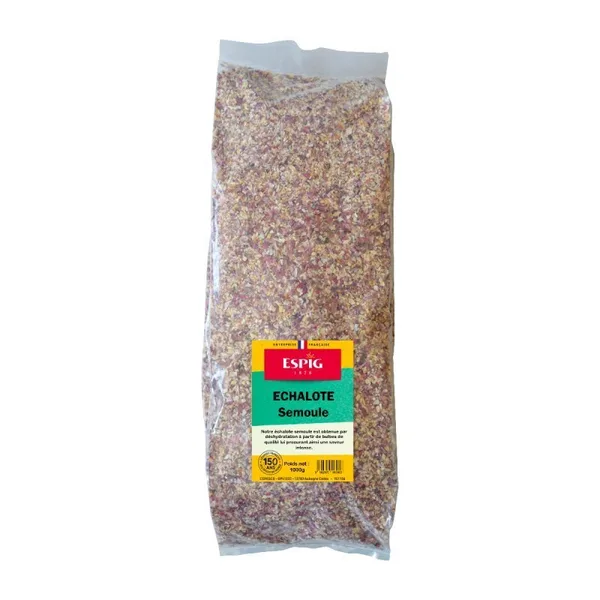
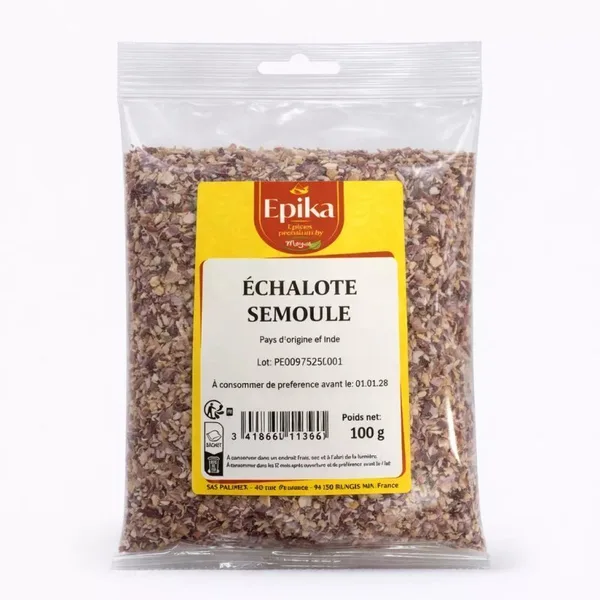
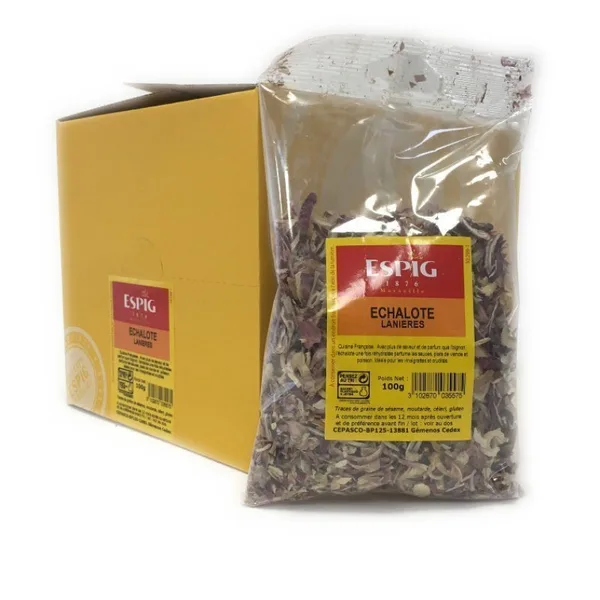
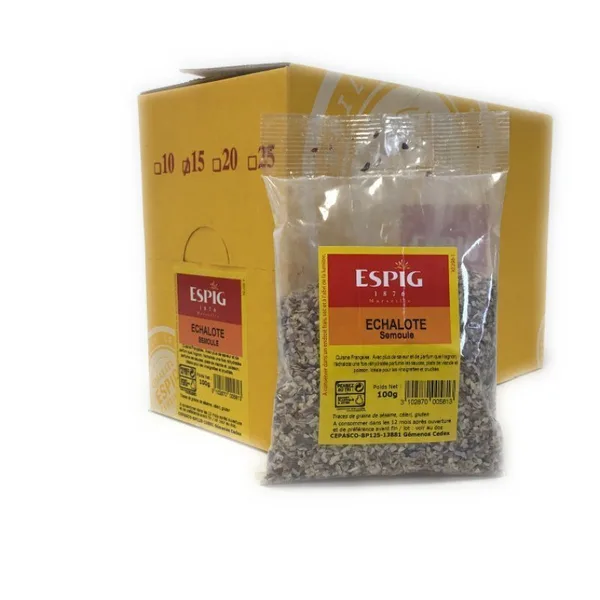
Granules are shallot reduced to a fine grain. They disperse into a sauce, a stuffing or a marinade, rehydrate on contact with the liquid and disappear visually: this is the form for sauce bases, compound butters and vinaigrettes made ahead. Strips, wider, stay visible after cooking. They are used where the shallot has to be seen as much as tasted — garnishes, pan-fried preparations, dishes where texture counts.
The choice is therefore made on the intended result, not on the price per kilo. A strained sauce base has no use for a strip; a garnish for white meat gains nothing from granules that dissolve. Many establishments end up carrying both, in very different volumes.
One useful point when ordering: granules and strips are not dosed at the same weight for an equivalent result, because the exchange surface is not the same. Run the test once, write the value on the recipe card, and you will not come back to it. It is the same calibration work as for any ground spice, and a single service is enough to complete it.
What dehydration changes in production
Switching to dried is not simply a time saving. The full calculation takes in several items that are easily forgotten when comparing with fresh product:
- No peeling at all, so no peelings to dispose of and a lighter organic waste bin.
- A stable yield: the weight measured is the weight used, with no trimming loss.
- An identical result whoever is on service, which no manual cutting can guarantee.
- Long storage at ambient temperature, taking up no cold room space.
- No seasonality: the product changes neither in size nor in behaviour through the year.
- Immediate use, with no board or knife to clean afterwards.
Available formats and stock rotation
Our range follows the pace of the kitchen. The case of 100 g units suits establishments with slow rotation or shelf resale; the 1 kg bag follows steady production. As everywhere on the spice aisle, the slower the rotation, the more a small pack protects the product.
| Form | Pack sizes | Typical use |
|---|---|---|
| Shallot granules | 1 kg bag, 15x100 g case | Sauce bases, stuffings, compound butters |
| Shallot strips | 15x100 g case | Garnishes, pan-fried dishes, visible preparations |
A word on grocery resale: the case of 100 g units goes onto the shelf as it is, with no repacking, which spares the retailer any handling of unwrapped food. It is an argument our grocer customers raise often, on a par with price, and it holds just as well for a kitchen that wants to open small.
Rehydration and storage
Dried shallot is used dry or rehydrated, depending on the preparation. The rule comes down to four steps:
- In a liquid preparation, add it directly: the product rehydrates as it cooks.
- In a dry or cold preparation, rehydrate separately in a little warm water before use.
- Never rehydrate more than the current service needs: once wet, the product is perishable again.
- Reseal an opened bag tightly and keep it away from the damp of the washing area.
Monitoring belongs in your food safety management plan like the rest of the store room: first-in first-out rotation, dated containers, lot marks and best-before dates kept until the pack is finished. For fresh sale, vegetables are also covered by European marketing standards published in the Official Journal — see Implementing Regulation (EU) No 543/2011 laying down detailed rules for the fruit and vegetables sector.
Our view as a wholesaler
Do not replace fresh shallot everywhere: keep it where it is seen raw. For everything that is cooked, blended or strained, granules do the same job while removing the peeling — and that is where the saving shows at the end of the month.
Our teams work every day with restaurateurs, caterers and fine grocers who buy in bulk. So we hold both particle sizes side by side rather than one average reference that would serve nobody. To round out your shelf, wholesale dehydrated garlic answers exactly the same peeling-saving logic, and wholesale cumin stands beside it in most marinades. Request your trade price: our wholesale terms apply from the first tier, with pallet delivery and carriage paid according to order value.