
Available products
11 references

Looking for a wholesale dried fruit supplier?
I'm Jessica, your dedicated wholesale account manager.
Direct sourcing — Rungis and Bordeaux.
- ✓Direct sourcing from producers
- ✓Quality controlled (shelf-life, calibre, origin)
- ✓Next-day delivery in Île-de-France
- ✓Bulk, custom packaging, co-packing
- ✓B2B account with pricing tiers
Shipping & pickup
Rungis pickup
Pick up your order at our Rungis market depot. By appointment Monday through Friday.
Nationwide delivery
Delivery within mainland France and major European cities. Indicative lead time 24-48h.
Careful packaging
Reinforced cardboard, anti-shock padding, traceability labels.
Frequently asked questions
About this category
Wholesale sesame: three colours, one single seed
Shelved among the spices, wholesale sesame is in fact a seed, and that changes how it should be bought. A food wholesaler since 1984, Palimex lists eleven variants under four labels — Epika, Espig, Meyva and Wissal — for the restaurateurs, bakers, caterers and grocers buying on a trade registration. The aisle reads on two axes only: colour, then pack size.
Colour announces no higher or lower grade: it announces a state of preparation and a use. That is the first thing to settle, and the only one that shows on the plate.
White, golden, black: what the colour signals
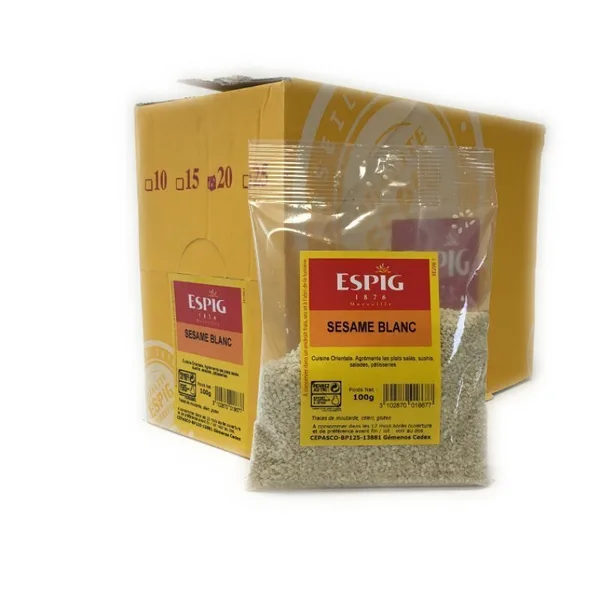
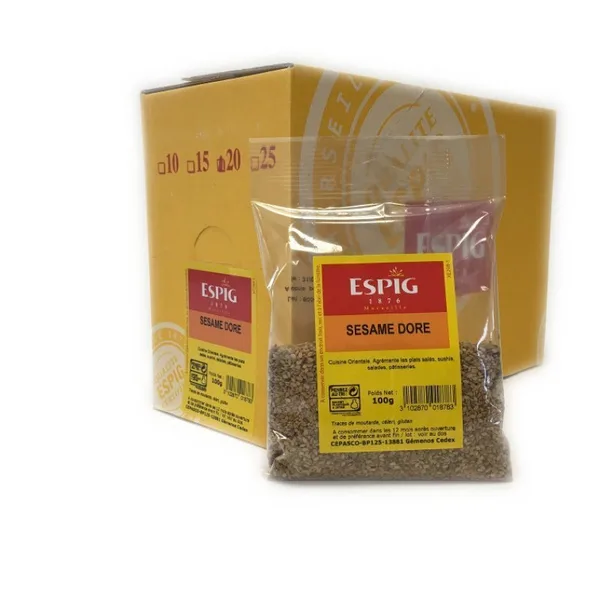
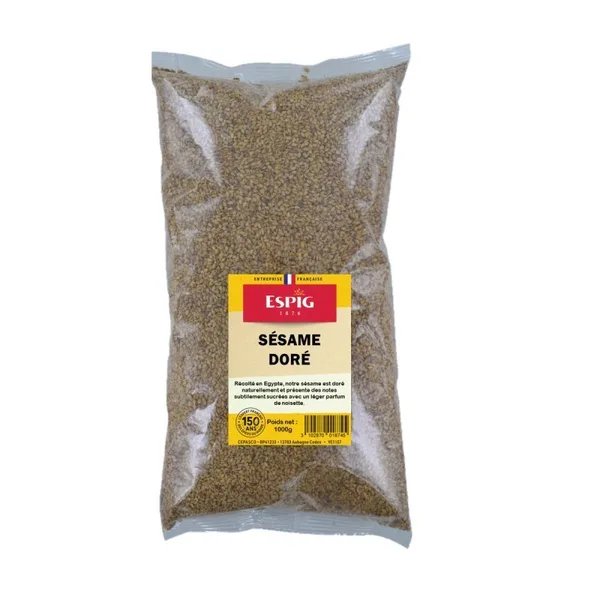
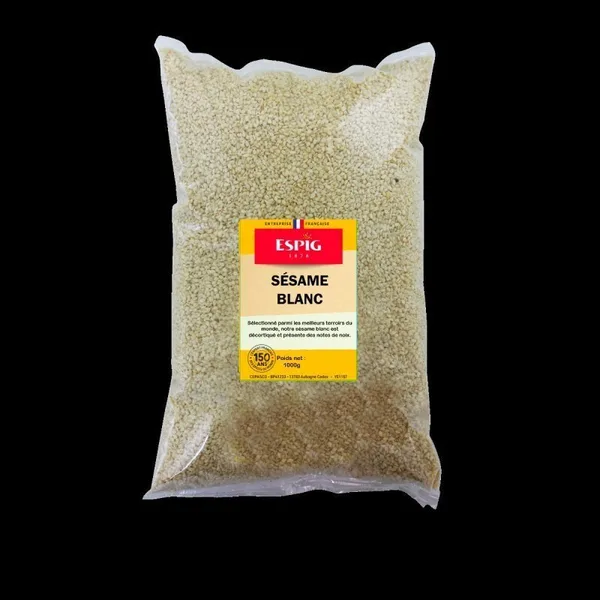
Hulled white sesame has lost its husk: it is pale, more tender under the tooth, and it melts into a preparation without drawing attention. Golden sesame keeps its husk and therefore keeps more bite. Black sesame works first through visual contrast, wherever the seed is meant to be seen.
| Colour | State in the catalogue | Where to use it |
|---|---|---|
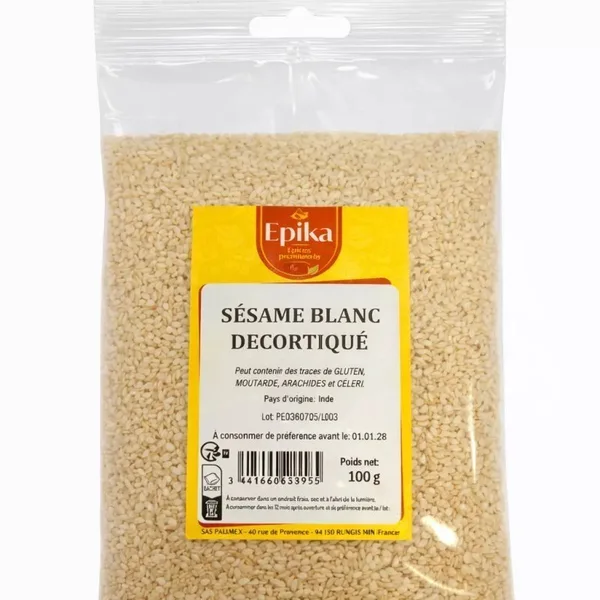
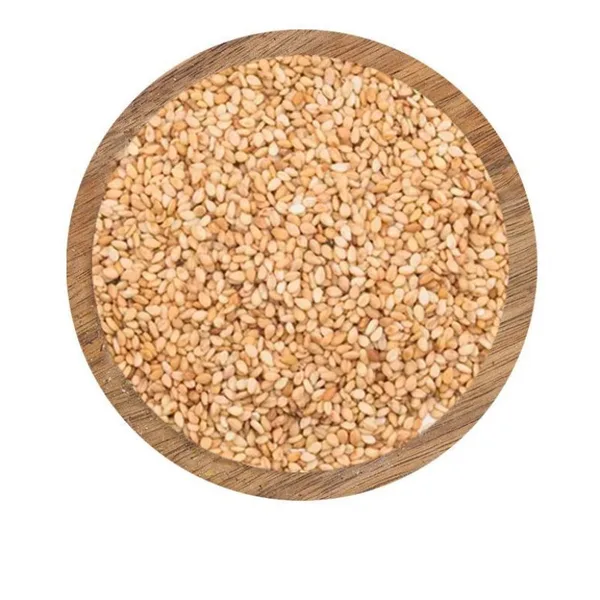
| White | Hulled in the 20x100 g case, whole in the 1 kg bag | Breads and viennoiserie, oriental pastry, preparations where the seed must blend in |
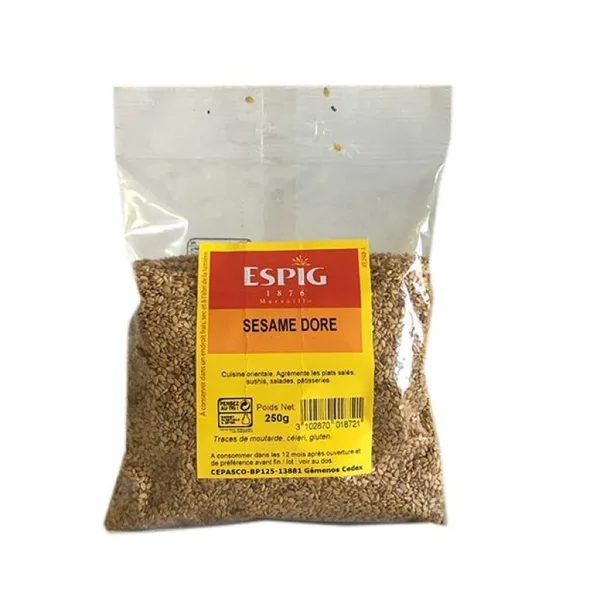
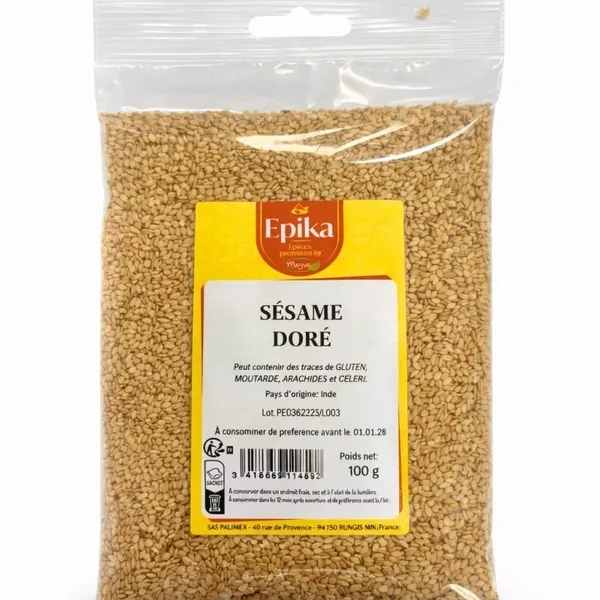
| Golden | Whole, from the 250 g bag to the 10x1 kg pack | Coatings and crusts, burger and sandwich breads, snacking, hot sprinkling |
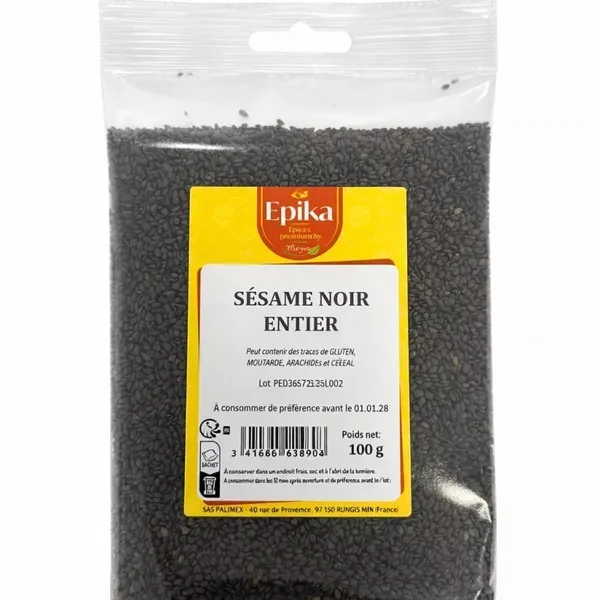
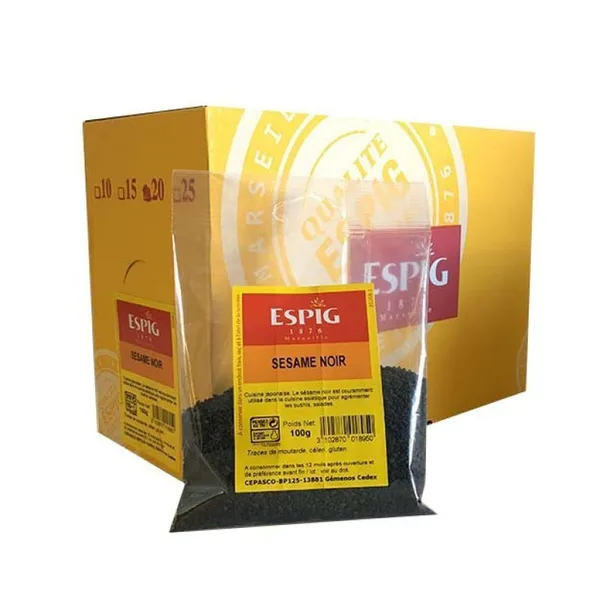
| Black | Whole, in the 20x100 g case | Finishing and plating, Asian cooking, contrast on pale preparations |
White deserves particular attention: with us it exists in two distinct states, hulled and whole. These are not two packagings of the same product but two different products, and it is the aisle's most frequent ordering mistake.
Hulled or whole: the one real technical question
Hulling means removing the husk that surrounds the seed. The consequence in the kitchen is direct: a hulled seed is more discreet, finer, and it colours faster under heat; a whole seed holds up more, stays perceptible under the tooth and takes long cooking better.
The choice is therefore made not on taste but on the place the seed occupies in the finished product. On a bread where sesame must stay visible and crunch, whole; in a dough or a pastry where it must not impose itself, hulled. Framing the question that way avoids buying two references where one would have done.
Toasting: the gesture that wakes the seed
A sesame seed delivered raw gives only part of what it holds. Toasting it to order is what wakes it, and it is done at the last moment, never in advance in large quantities:
- Heat a dry pan over a medium flame, with no fat at all.
- Tip in the sesame in a single layer, without crowding the surface.
- Stir without pause: the seed goes from golden to burnt in a few seconds, and a burnt seed is bitter right through.
- Turn it out at once onto a cold tray — in the hot pan it goes on cooking.
This is exactly the gesture wholesale cumin calls for, and for the same reason: dry heat releases what storage had put to sleep. The whole seeds of the aisle, such as wholesale coriander or wholesale fennel, all answer to this principle.
An allergen that must be declared
This is the most important point in the aisle, and there is nothing culinary about it. Sesame is one of the allergenic substances whose mention is mandatory in the European Union: it must appear in the information given to the consumer, in catering as in retail. The European framework on food information to consumers is what makes that obligation legible and enforceable.
For a kitchen this has two practical consequences. First: sesame must appear on your display or your menu as soon as it enters a recipe, including as a simple decoration on a bread. Second: a seed that travels — across a worktop, into a fryer, onto a shared tray — ends up where it was not planned. It is an ingredient that calls for a fixed place in the storeroom and a clean gesture at the station.
Pack sizes in the aisle
Once the colour is settled, pack size is chosen on rate of consumption, not on the headline price of the case:
- The 250 g bag, for a trial or occasional use without tying up stock.
- The 1 kg bag, for steady use at a single station.
- The 20x100 g case, in all three colours: each unit stays sealed until it is opened, which suits multiple stations as well as shelf stock.
- The 20x400 g case, an intermediate size for regular production.
- The 10x1 kg pack, for bakeries and central kitchens using golden sesame by volume.
Golden is in fact the best-served colour in the aisle: it is the one we carry from the smallest to the largest pack, because it is the one that moves fastest in coatings and in baking.
Our view as a wholesaler
With sesame, the buying mistake is almost never the colour: it is ordering hulled when whole was wanted, or the other way round. Write the state — hulled or whole — on your recipe sheet next to the colour, and the problem disappears for good.
Our teams deliver every week to bakeries, caterers and grocers working sesame by volume. That is why we hold four labels and five pack sizes, so that everyone finds the size they will use up within a reasonable time rather than the largest case available. Find the whole aisle at your wholesale spice supplier and request your trade price: our bulk terms apply from the first tier, with pallet delivery and carriage paid depending on order value.