
Available products
6 references

Looking for a wholesale dried fruit supplier?
I'm Jessica, your dedicated wholesale account manager.
Direct sourcing — Rungis and Bordeaux.
- ✓Direct sourcing from producers
- ✓Quality controlled (shelf-life, calibre, origin)
- ✓Next-day delivery in Île-de-France
- ✓Bulk, custom packaging, co-packing
- ✓B2B account with pricing tiers
Shipping & pickup
Rungis pickup
Pick up your order at our Rungis market depot. By appointment Monday through Friday.
Nationwide delivery
Delivery within mainland France and major European cities. Indicative lead time 24-48h.
Careful packaging
Reinforced cardboard, anti-shock padding, traceability labels.
Frequently asked questions
About this category
Wholesale fennel seed, the aniseed note
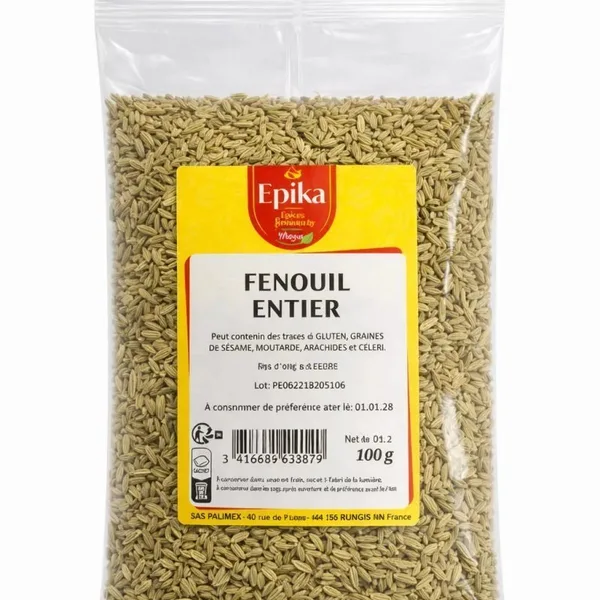
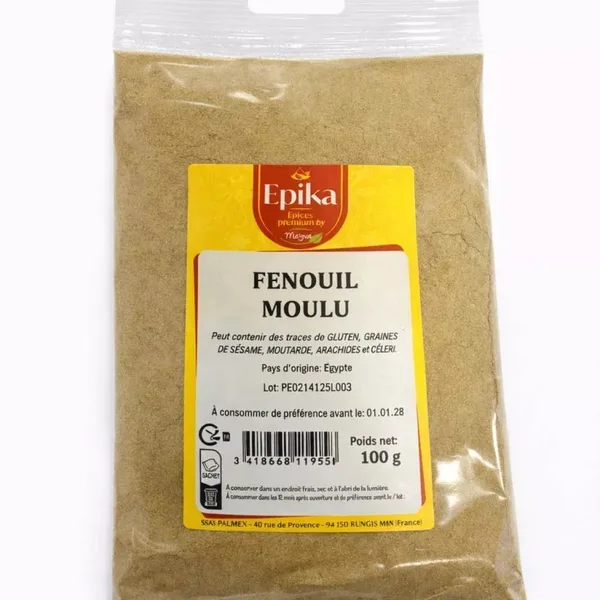
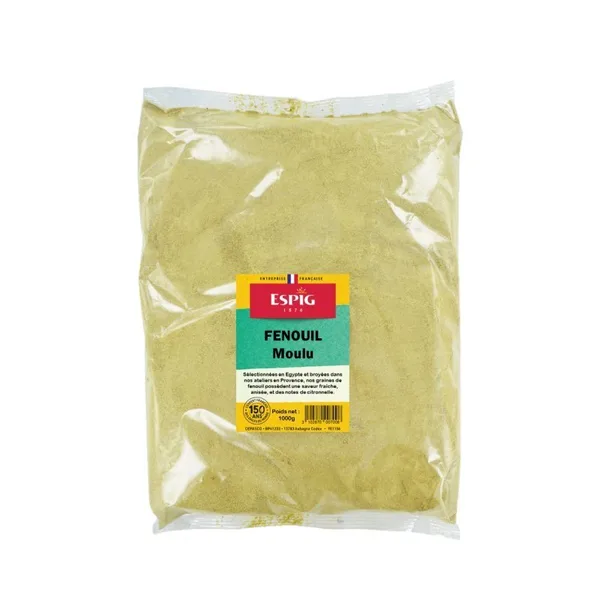
Wholesale fennel seed is a trade spice rather than a menu spice: it is rarely named on a card, yet it signs whole preparations. It is what gives the aniseed note to a sausage meat, a seeded loaf, a fish stock or a pork marinade. A food wholesaler since 1984, Palimex lists it under the Epika and Espig labels, as whole seed and as ground fennel.
Whole or ground: two moments of use
Whole seed stays visible and gives a slight crunch. It is scattered on a loaf before baking, dropped whole into a stock or a brine, toasted for a few seconds to open its scent. Ground fennel, by contrast, melts into the mass: it is the form for stuffings, sausage meats, dry blends and anything that has to be homogeneous right through.
Many of our customers carry both, in very different volumes: the ground form goes quickly in production, while the whole seed lasts longer because it only serves precise gestures. The rule is the same as across the rest of the aisle: whole seed keeps its aroma far longer than a powder, because it exposes almost no surface to the air.
A word on dosage, because that is where fennel most often goes wrong: its aniseed note rises during cooking and keeps developing as the preparation rests. A stuffing tasted raw seems discreet; the same stuffing cooked and cooled can turn overpowering. The only reliable method is therefore to cook a sample, let it cool and taste it then — and to write down the chosen quantity so the test never has to be repeated.
The trades that use it
Fennel is not a universal spice: it has precise ground, and that is what makes it worth listing. Here is where our customers use it most:
- Charcuterie and catering: sausage meats, terrines, potted meats, aromatic brines.
- Bakery: country loaves and rolls where the seed stays visible on the crust.
- Fish cookery: stocks, court-bouillons, marinades for oily fish.
- Mediterranean cooking: braised vegetables, preparations in oil, slow-cooked dishes.
- House blends: paired with coriander or cumin in dry mixes.
Since fennel seed is used heavily in charcuterie, it is worth recalling that meat preparations fall under specific hygiene rules published in the Official Journal of the European Union — see Regulation (EC) No 853/2004 laying down specific hygiene rules for food of animal origin.
Available formats and stock rotation
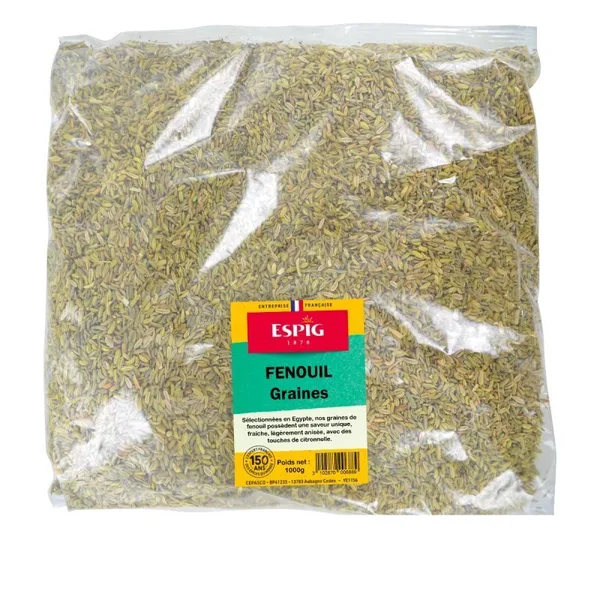
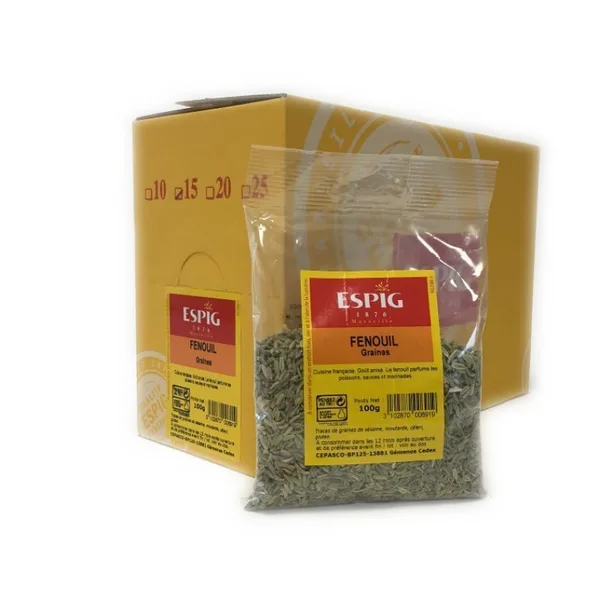
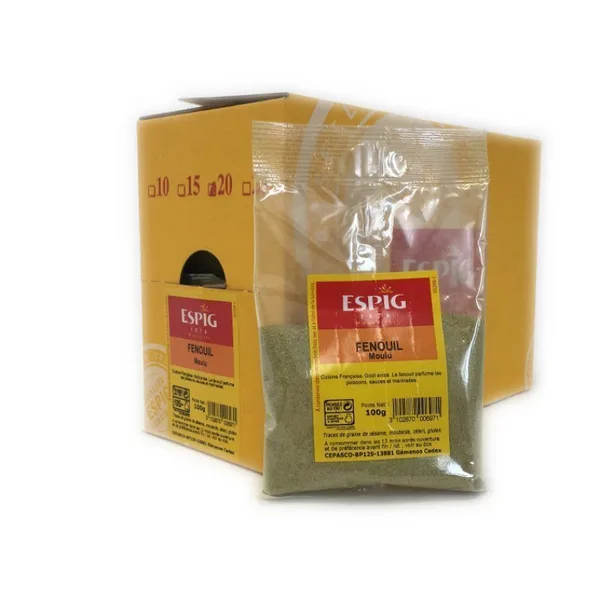
Our range follows the pace of production. The 1 kg bag suits workshops using fennel every week; the case of 100 g units protects the product better in businesses with slow rotation and goes onto the shelf as it is for resale.
| Form | Pack sizes | Typical use |
|---|---|---|
| Whole fennel | 1 kg bag, 15x100 g case | Breads, stocks, brines, dry toasting |
| Ground fennel | 1 kg bag, 20x100 g case | Stuffings, sausage meats, dry blends |
Choosing a format is therefore not only a matter of price per kilo. A baker scattering seed on loaves all year round uses it steadily and gains from the bag; a restaurant using it on two seasonal preparations is far better served by the case, which spares them keeping a kilo open for six months. We see both cases every week, and it is almost always the pace of use, not the annual volume, that settles it.
Handling and storage
Fennel is easy to work with, provided a few steps are respected. The method comes down to four points:
- Toast whole seed dry for a few seconds before crushing it, never longer than that.
- Crush at the last moment rather than opening a powder stored for months.
- In a stuffing, add the ground form cold and let it rest before a test cook.
- Taste the cooked preparation, never the raw one: aniseed reveals itself under heat.
In the store room the rules are those of any dry spice and belong in your food safety management plan: storage away from light and damp, resealed and dated containers, first-in first-out rotation, lot marks and best-before dates kept until the pack is finished.
Our view as a wholesaler
If you were to carry only one form, take the whole seed: it keeps better and you can always crush it. The ground form is only justified if you produce stuffing in quantity — there it saves real time and gives a steadier result.
Our teams work every day with charcutiers, caterers, bakers and fine grocers who buy in bulk. So we hold both forms from two suppliers, so that your supply never depends on a single reference. To round out your shelf, wholesale coriander seed follows the same whole-versus-ground logic and pairs naturally with fennel, and wholesale cumin completes the dry blends. Request your trade price: our wholesale terms apply from the first tier, with pallet delivery and carriage paid according to order value.